

Web Summit Qatar 2026: The $205 Million Web Summit Investment Signal for GCC Growth Capital

The numbers don't lie. When 69 startups collectively raise $205 million in the months following Web Summit Qatar 2026, you're witnessing more than entrepreneurial enthusiasm: you're seeing a fundamental shift in capital allocation priorities across the Gulf Cooperation Council region.
Web Summit Qatar 2026, held February 1-4 in Doha, served as a crystallizing moment for what disciplined investors have recognized for months: AI and robotics aren't just trending sectors: they're becoming the backbone of how growth capital in the Middle East gets deployed in 2026 and beyond. For investment holdings like Licorne Gulf, Web Summit Qatar 2026 is the key driver behind this $205 million investment signal—a concentrated set of market observations that sharpens how we evaluate scalability, industrial application, and long-term value creation.
Let's examine what the Web Summit Qatar 2026 signal actually means and why the dominance of AI and robotics in GCC portfolios reflects strategic foresight rather than speculative fever.
The $205 Million Breakdown: What Web Summit Qatar 2026 Signaled About Capital Allocation
Here's what makes the Web Summit fundraising story compelling: the capital wasn't distributed evenly across sectors. AI and machine learning startups captured $125 million of the total $205 million raised: representing over 60% of all funding. Data and analytics companies secured $41 million, while fintech accounted for $26 million.
This isn't random. The concentration tells us that investors are making deliberate bets on infrastructure-level technologies rather than application-layer innovations. AI and robotics represent foundational shifts in how businesses operate, automate, and scale: precisely the characteristics that justify significant growth capital commitments.
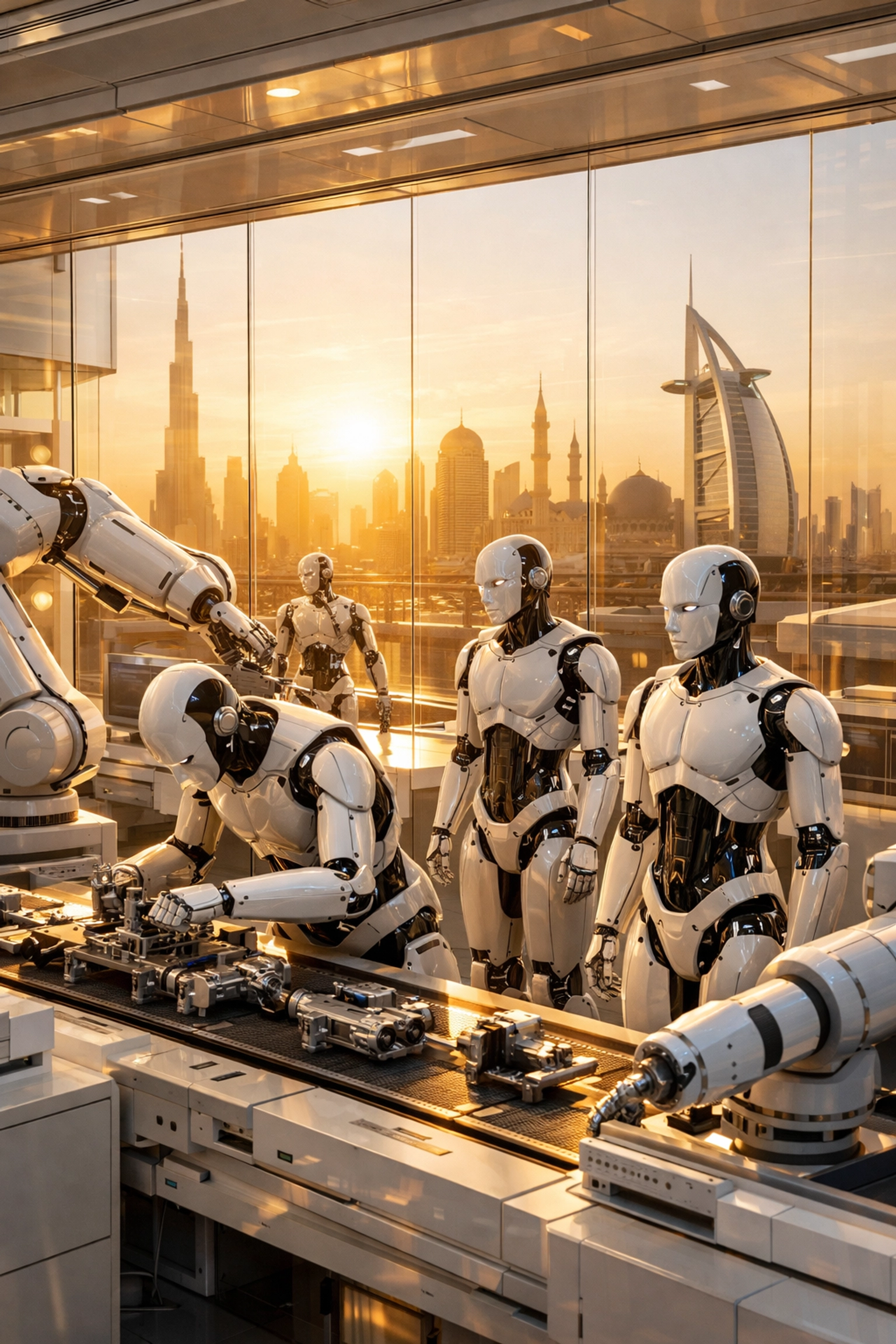
Consider the practical demonstrations at Web Summit Qatar 2026: educational robots designed for children, automation solutions for logistics, and semiconductor applications enabling AI integration across everyday devices. These weren't moonshot concepts; they were commercially viable products addressing immediate market needs. The robotics startups showcased at Web Summit emphasized real-world applications, from manufacturing efficiency to service automation: sectors where the GCC is actively building capacity.
What we're observing is capital following capability. The $205 million raised by these startups mirrors a much larger institutional movement, and understanding this connection is essential for anyone involved in private equity investments or business growth strategies in the region.
Web Summit and the Infrastructure Wave Behind the Startup Signal
The $205 million startup funding figure becomes even more significant when contextualized within the GCC's broader AI infrastructure investments. This isn't just about supporting startups: it's about positioning the entire region as a global AI powerhouse.
The Gulf states are committing USD 5-7 billion to AI data-centre infrastructure in 2026 alone, with over USD 30 billion planned through 2030. These aren't abstract pledges; they're active deployments already reshaping the region's technological landscape.
Saudi Arabia has established HUMAIN as its national AI champion, partnering with AirTrunk for USD 3 billion in AI data-centre deployment. Center3 has announced multi-billion-dollar expansion plans that will create unprecedented computational capacity within the Kingdom.
The UAE launched Stargate UAE, backed by USD 8-10 billion to deploy 1 gigawatt of AI data-centre capacity. Microsoft committed USD 7.9 billion for expansion through Khazna Data Centers between 2026-2029: one of the largest single technology infrastructure investments in the region's history.
Qatar's Ooredoo subsidiary Syntys secured USD 1 billion for sovereign AI cloud services, while Kuwait has attracted both Google Cloud and Microsoft Azure to establish cloud regions with dedicated AI capacity.
This infrastructure spending creates a multiplicative effect for startups operating in AI and robotics. When a startup can access world-class computational resources, sophisticated cloud infrastructure, and regional data sovereignty protections, its scaling potential increases exponentially. The $205 million raised at Web Summit Qatar isn't funding startups that will struggle to find infrastructure: it's capitalizing companies that can immediately leverage billions of dollars in supportive ecosystem investments.
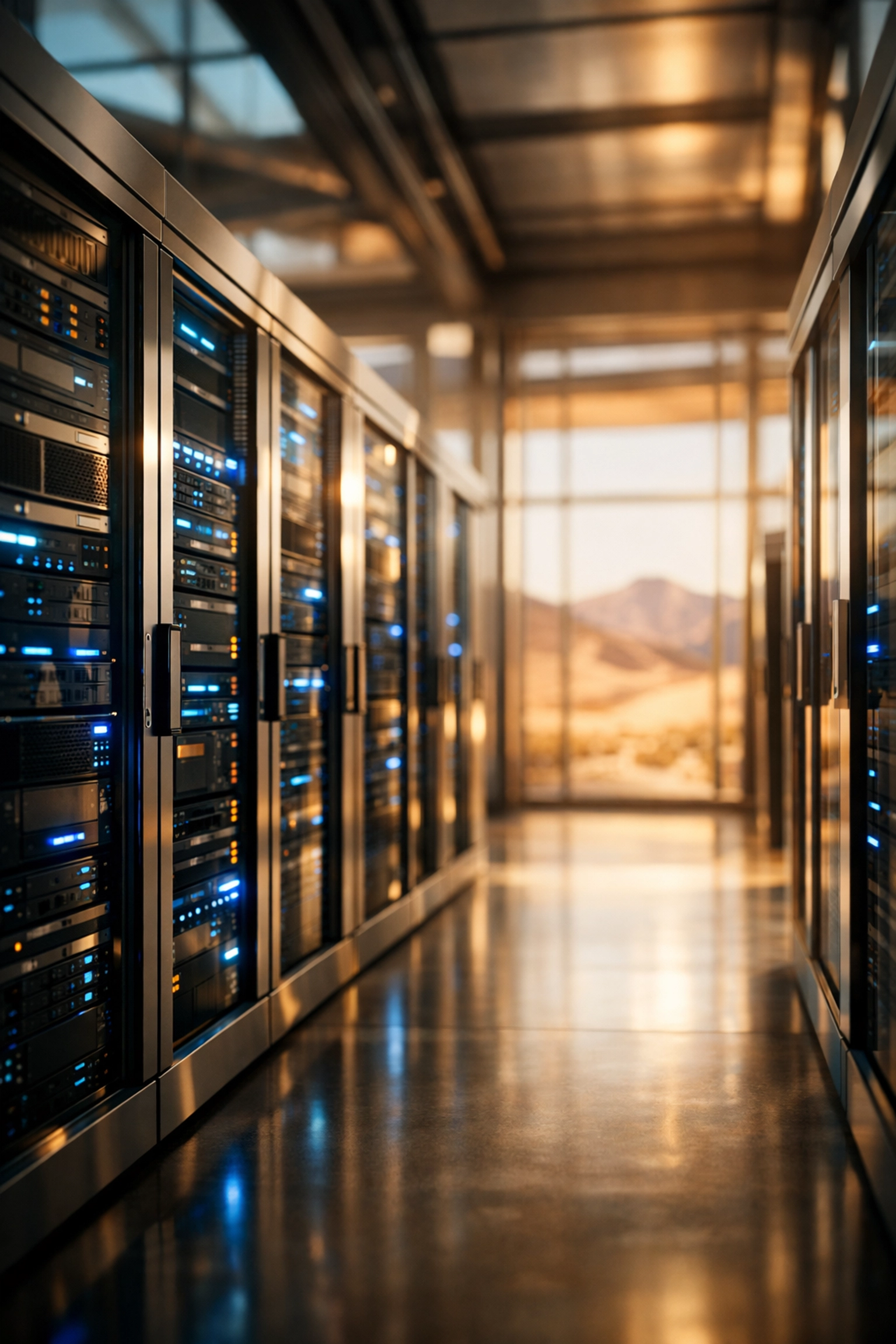
For investment holdings evaluating opportunities in growth capital Middle East, this infrastructure context fundamentally changes risk assessment. We're not betting on isolated companies hoping to succeed despite their environment; we're identifying ventures positioned to thrive because of deliberate, well-capitalized ecosystem development.
Why Web Summit Qatar 2026 Put AI and Robotics at the Center
The dominance of AI and robotics in GCC investment portfolios reflects three converging forces: economic diversification imperatives, technological maturity, and competitive positioning.
First, Gulf nations are executing ambitious economic diversification strategies away from hydrocarbon dependence. AI and robotics represent sectors where the region can build comparative advantage through capital deployment rather than relying solely on natural resource endowments. These technologies enable the creation of knowledge-based economies: precisely what business growth strategies in the region now prioritize.
Second, these technologies have reached commercial viability. Unlike earlier waves of hype around emerging technologies, today's AI and robotics solutions deliver measurable ROI in manufacturing, logistics, healthcare, and financial services. The startups at Web Summit Qatar 2026 weren't pitching concepts; they were demonstrating revenue, contracts, and scaling operations.
Third, the global competition for AI supremacy creates urgency. The GCC recognizes that early positioning in AI infrastructure and robotics manufacturing will determine regional competitiveness for decades. This isn't speculative: it's strategic necessity.
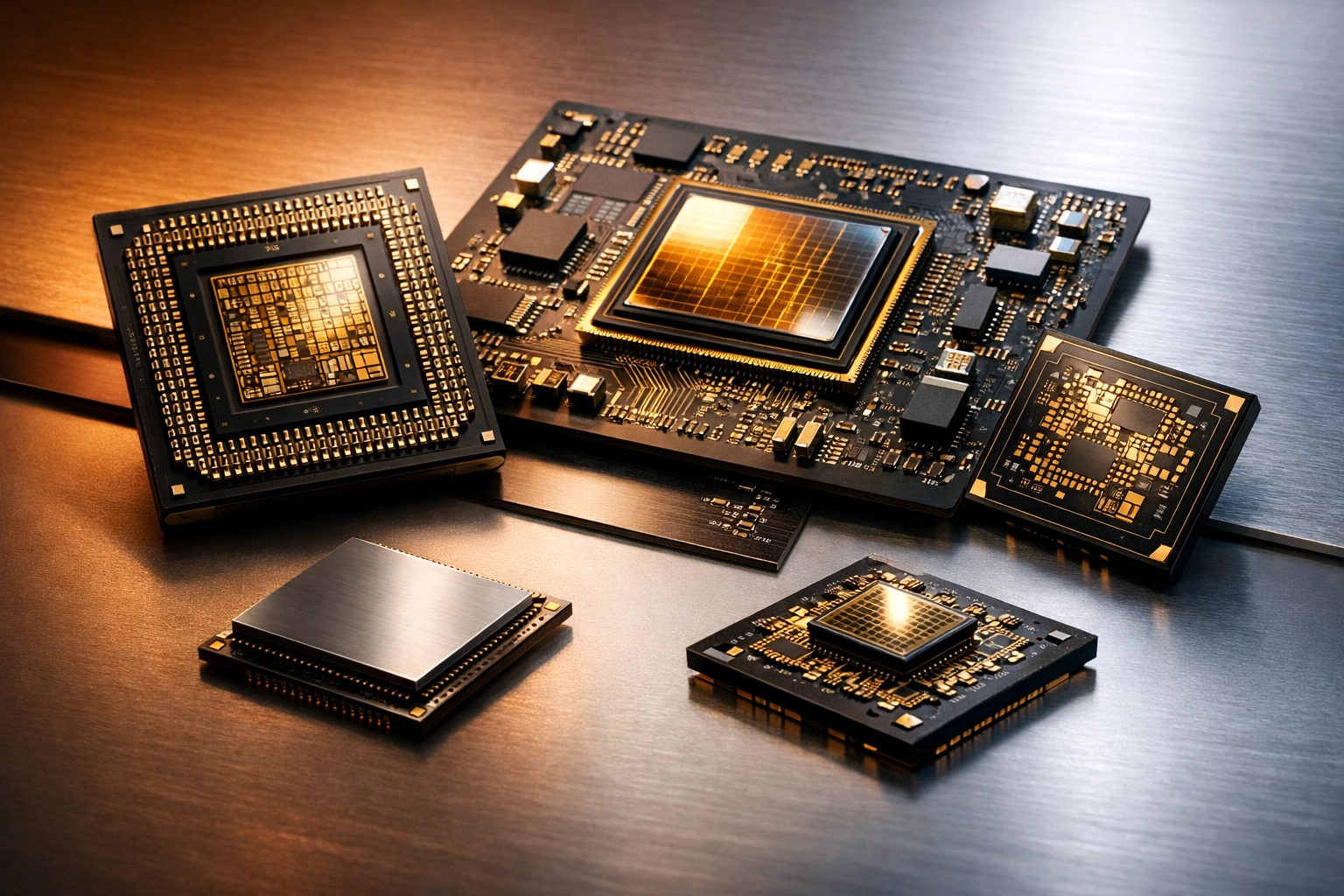
The emphasis on semiconductors and chips underscores this point. These foundational components enable AI integration across personal devices, industrial equipment, and smart city infrastructure. By investing in both the semiconductor supply chain and the applications it enables, Gulf investors are building vertically integrated technological ecosystems.
Beyond the Pitch: How We Translate Web Summit Insights Into Long-Term Value
Web Summit Qatar 2026 generated excitement, but excitement doesn't pay dividends. At Licorne Gulf, our approach to evaluating AI and robotics opportunities uses Web Summit as a signal source, then focuses on what happens after the pitch deck closes: when scaling, operational execution, and market adoption determine actual returns.
We assess three critical dimensions when considering private equity investments in these sectors—especially when opportunities originate from Web Summit conversations and follow-on introductions:
Scalability Architecture: Can this technology expand across markets without proportional cost increases? True AI and robotics solutions demonstrate network effects and declining marginal costs as deployment grows. We look for companies whose economic models improve with scale rather than simply maintaining margins.
Industrial Application Depth: Technologies that integrate into existing industrial workflows typically outperform consumer-facing novelties. The robotics companies raising capital at Web Summit Qatar focused on manufacturing, logistics, and education: sectors with clear budgets, procurement processes, and measurable efficiency gains. These are qualities that support growth capital Middle East deployments.
Regulatory and Sovereignty Alignment: In the GCC context, technologies that enhance national capabilities while respecting data sovereignty requirements enjoy structural advantages. AI solutions that can operate within local regulatory frameworks: particularly regarding data residency and security: face fewer adoption barriers than globally standardized platforms requiring regulatory exceptions.
This evaluation framework distinguishes between companies riding short-term trends and those building durable competitive advantages. The $205 million signal matters not because startups raised capital, but because they raised capital while demonstrating these deeper value characteristics.
The Web Summit Playbook for Growth Capital in the Region
What does this mean for companies seeking growth capital Middle East? The dynamics have shifted fundamentally.
Traditional fundraising centered on narrative and vision. Today's successful capital raises in AI and robotics combine compelling vision with demonstrable traction in industrial applications. Investors want to see pilot deployments, enterprise contracts, and operational metrics: not just addressable market calculations and future revenue projections.
The infrastructure investments across the GCC create opportunities for startups that might have struggled in other markets. A robotics company requiring significant computational resources can access Saudi Arabia's expanding AI data centres. An AI-powered analytics platform can leverage UAE cloud infrastructure without the latency issues that might hamper operations elsewhere.
For companies in the scaling phase, this means your corporate finance expertise must extend beyond capitalization tables and term sheets. You need to understand how your technology integrates with regional infrastructure investments, how your solution addresses diversification priorities, and how your growth trajectory aligns with national AI strategies.
The concentration of funding in AI and machine learning: $125 million of the $205 million total: signals where investors see the most defensible moats and sustainable competitive advantages. These aren't sectors where first-mover advantage disappears quickly or where competition immediately commoditizes returns.
How We Translate Web Summit Signals Into Licorne Gulf’s Investment Holding Lens
As an investment holding with corporate finance expertise spanning multiple sectors, we view the AI and robotics dominance through a portfolio lens. These technologies aren't isolated opportunities; they're reshaping every industry in which we operate and evaluate.
Our approach integrates three principles:
We seek convergence opportunities where AI and robotics enhance traditional sectors rather than replacing them. The most compelling investments often occur at the intersection of emerging technology and established industries: logistics companies adopting autonomous systems, healthcare providers integrating diagnostic AI, or financial institutions deploying robotics process automation.
We prioritize ecosystem positioning over isolated company evaluation. A startup's technology matters less than its ability to leverage the USD 30 billion in regional AI infrastructure being deployed through 2030. Companies that align with HUMAIN's objectives in Saudi Arabia, Stargate UAE's capacity, or Qatar's sovereign AI cloud initiatives enjoy structural advantages worth more than marginal product improvements.
We emphasize patient capital deployment. The infrastructure investments unfolding across the GCC create multi-year opportunities. Rather than chasing quarterly milestones, we structure investments that allow companies to scale deliberately, integrate deeply into industrial applications, and build sustainable competitive advantages.

This patient, integrated approach differentiates investment holdings from purely financial investors. We're not allocating capital to maximize short-term IRR; we're building positions in companies that will define regional technological capabilities for decades.
What Comes Next After Web Summit Qatar 2026
The $205 million raised following Web Summit Qatar 2026 represents an inflection point, not a conclusion. As GCC infrastructure investments mature, we'll see secondary effects that amplify opportunities in AI and robotics.
Talent migration will accelerate as the region's AI ecosystem offers competitive opportunities with established tech hubs in Europe and Asia. The combination of infrastructure, capital availability, and government support creates conditions where top engineering and research talent can build globally competitive companies without relocating to Silicon Valley or Shenzhen.
Vertical integration will deepen as Gulf investors recognize opportunities across the entire AI value chain: from semiconductors to data centres to applications to maintenance and training services. This vertical integration mirrors the region's historical approach in energy sectors, applying proven organizational capabilities to emerging technologies.
Cross-border collaboration will intensify as GCC nations coordinate rather than compete in AI development. The infrastructure investments in Saudi Arabia, UAE, Qatar, and Kuwait create complementary capabilities rather than redundant efforts, enabling regional companies to access broader markets and resources.
For companies positioned at this intersection of technological capability and regional infrastructure investment, the next 24 months will be formative. The startups that raised capital after Web Summit Qatar 2026 have a runway to prove their models, refine their applications, and establish market positions before the next wave of competitors emerges.
The Web Summit Signal and the Strategy
The $205 million isn't remarkable because of its size: venture capital and private equity investments regularly exceed that figure in individual transactions. It's remarkable because of what Web Summit Qatar 2026 signals about where sophisticated capital is flowing and why.
AI and robotics dominate GCC growth capital because they align with regional strategic priorities, leverage unprecedented infrastructure investments, and address real industrial needs. This isn't hype-driven allocation; it's calculated positioning for a technological transition that will reshape global competitiveness.
At Licorne Gulf, we recognize that today's decisions about AI and robotics investments will determine portfolio performance for years to come. The companies demonstrating scalability, industrial application depth, and alignment with regional capabilities will generate the returns that justify growth capital commitments.
The question isn't whether AI and robotics will dominate GCC investments: that ship has sailed. The question is which companies will leverage this moment to build enduring competitive advantages and which investors will position themselves to capture that value creation.
The Web Summit signal is clear. How you respond determines everything else.


Comments